
Comparison Filed Oct 12, 2026 by Erika & Joe
Ricoh GR IIIx vs Canon G7 X Mark III: which pocket camera to buy
Checked on . Erika & Joe.
Our verdict
Buy the Ricoh GR IIIx if you mostly take still photos and want top image quality in a jeans pocket: APS-C, 40 mm-equivalent f/2.8, 262 g, $1,249.95 [1]. Buy the Canon G7 X Mark III for video, selfies or zoom: 24–100 mm, a 180° flip screen, 4K and a mic jack, from $879.99, out of stock [2]. It has an APS-C sensor, much larger than the 1-inch sensors in zoom compacts, a fixed 40 mm-equivalent f/2.8 lens, and weighs 262 g, for $1,249.95 [1]. Buy the Canon G7 X Mark III if you shoot video, selfies or need zoom. It has a 24–100 mm-equivalent f/1.8–2.8 lens, a screen that flips 180°, 4K 30p video and a mic jack [2]. Canon's store lists it from $879.99 but out of stock [2].
The short answer
The Ricoh GR IIIx is the better stills camera: a 24 MP APS-C sensor, sensor-shift stabilization and a fixed 40 mm-equivalent lens in a 262 g body, for $1,249.95 [1]. The Canon G7 X Mark III is the better video and all-round travel camera: a 20.1 MP 1-inch sensor, a 4.2x zoom, a 180° flip screen, 4K 30p and a 3.5 mm mic input, listed from $879.99 [2]. Checked on the makers' US sites on 2026-10-16.
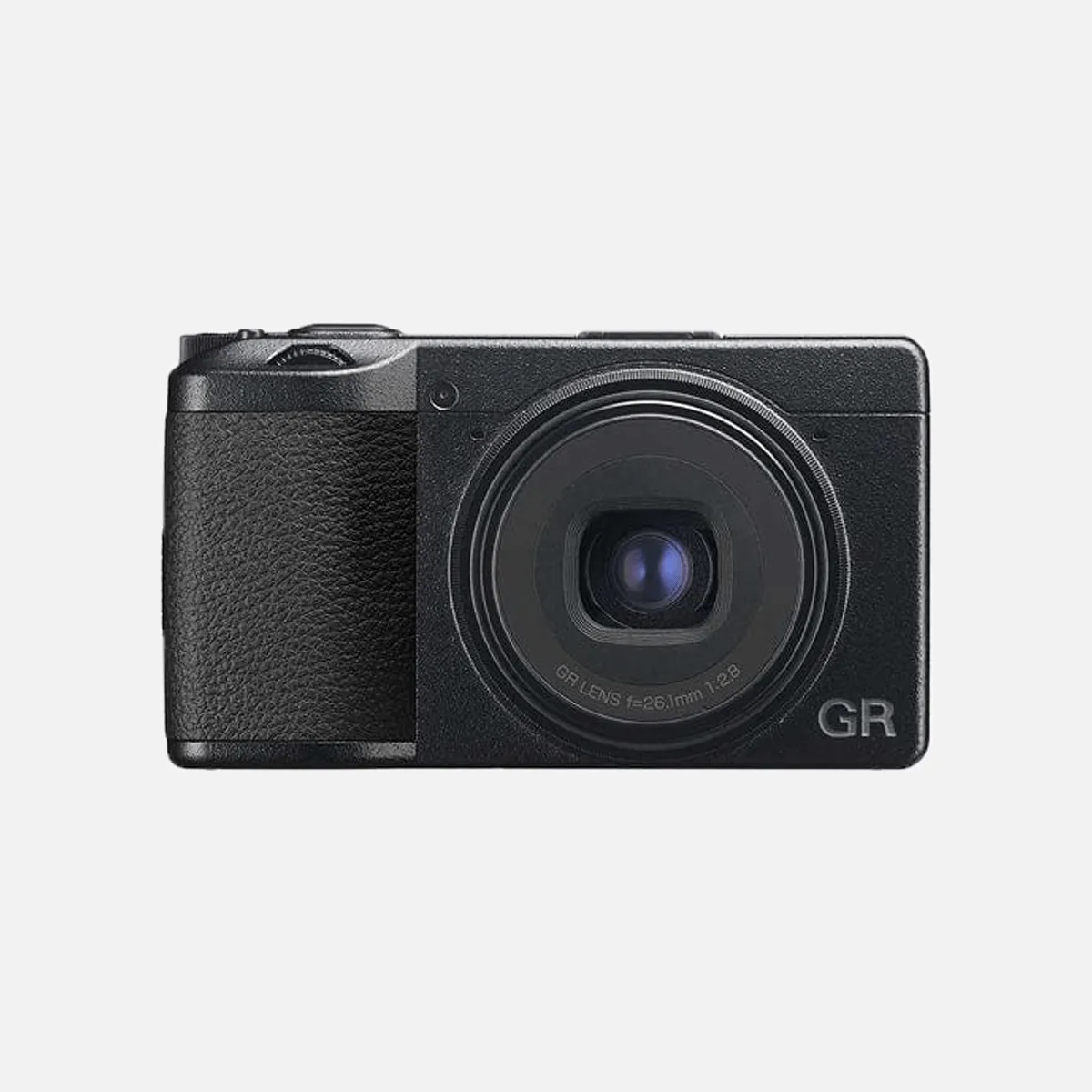
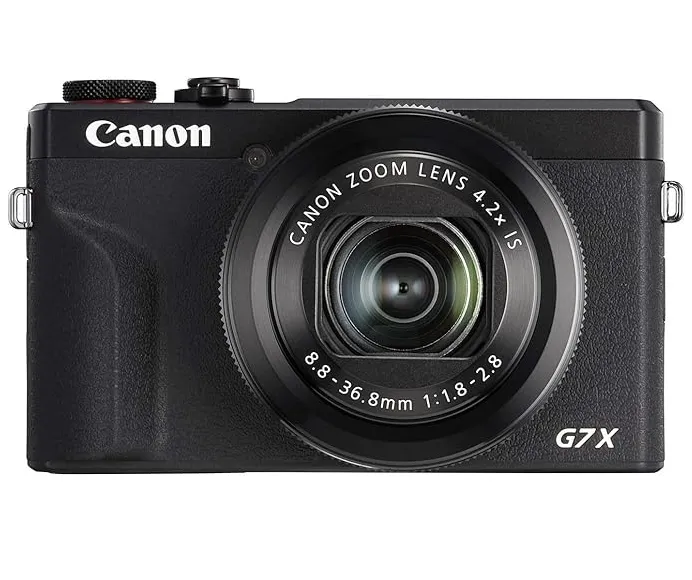
Side by side (makers' pages, checked 2026-10-16)
| Spec | Ricoh GR IIIx | Canon G7 X Mark III |
|---|---|---|
| Price | $1,249.95 [1] | "As low as $879.99," out of stock [2] |
| Sensor | APS-C, about 24.24 MP, no AA filter [1] | 1.0-inch stacked CMOS, 20.1 MP [2] |
| Lens | 26.1 mm (about 40 mm equiv.) f/2.8, fixed [1] | 24–100 mm equiv. f/1.8–2.8, 4.2x optical zoom [2] |
| Crop modes / zoom | 50 mm and 71 mm crops [1] | 4x digital zoom on top of optical [2] |
| Stabilization | 3-axis sensor shift, up to 4 stops [1] | Optical IS [2] |
| Closest focus | 12 cm in macro mode [1] | 5 cm at the wide end [2] |
| Screen | 3.0 in fixed touch LCD [1] | 3.0 in touch LCD, tilts 180° [2] |
| Viewfinder | None; optional GV-3 external finder [1] | None [2] |
| Video | Full HD up to 60p [1] | 4K 29.97p, Full HD up to 119.88p [2] |
| Mic input | Not in our source | 3.5 mm [2] |
| Live streaming | No | Yes, to YouTube [2] |
| Built-in flash | Not in our source | Yes [2] |
| Battery (CIPA) | About 200 shots [1] | About 235 shots, 320 in ECO mode [2] |
| Charging | USB-C [1] | USB-C in-camera charging, about 110 min with Canon's PD-E1 adapter [2] |
| Weight | 262 g with battery and card [1] | 304 g with battery and card [2] |
| Size | 109.4 x 61.9 x 35.2 mm [1] | 105.0 x 60.9 x 41.4 mm [2] |
| Operating temp | Not in our source | 0–40°C [2] |
Full cost
The real difference: sensor or zoom
Image quality. The Ricoh's APS-C sensor is physically much larger than the Canon's 1-inch sensor [1][2]. In practice, that means cleaner low-light pictures and more natural background blur at the same framing. Ricoh owners say the pictures look good straight out of a pocket camera [3]. A Canon owner who hikes and mountain-bikes with a Mark III says focus and low light are worse than their Canon RP full-frame camera [4], which is the trade any 1-inch compact makes.
Lens. The Ricoh has one focal length, 40 mm equivalent, with crop modes to 50 and 71 mm [1]. You zoom with your feet. The Canon zooms from 24 to 100 mm [2]. For landscapes that need wide, or a distant ridgeline, the Canon is more flexible. Its f/1.8 wide end is also brighter than the Ricoh's f/2.8 [1][2].
Video and vlogging. No contest. The Canon records 4K at 29.97 fps, Full HD up to 119.88 fps, has a 3.5 mm mic jack, flips its screen 180° for selfies and can live-stream to YouTube [2]. The Ricoh records Full HD up to 60p and has a fixed screen [1].
Size. The Ricoh is thinner, 35.2 mm against 41.4 mm, and lighter, 262 g against 304 g [1][2]. Both fit a jacket pocket. The Ricoh is the one owners describe shooting one-handed [3][5].
Reliability complaints. Both have lens covers that owners say can stick. Ricoh owners report a lens window that won't open fully [6]. A Canon owner found the lens shutters wouldn't open fully after five days [7]. Another Canon owner says the Mark III lens has autofocus issues that firmware never fixed [8]. A four-year Ricoh owner calls it the most fragile camera they've owned [5].
Battery. Both are short. Ricoh rates about 200 shots and Canon about 235, or 320 in ECO mode [1][2]. Carry spares for either.
Pick the Ricoh GR IIIx if
Pick the Canon G7 X Mark III if
Or consider
If you want more zoom than either, the Sony RX100 VII reaches 200 mm equivalent for $1,499.99 [9]. See Sony RX100 VII vs Canon G7 X Mark III and our pocket travel cameras roundup.
In the desert
Dust. Both lenses retract behind small covers, and owners of both report covers that stick [6][7]. Keep the camera in a zip bag on dirt roads. Ricoh adds ultrasonic sensor cleaning [1], which shakes dust off the sensor but can't clean the lens cover.
Heat. Canon rates the G7 X Mark III from 0 to 40°C [2]. Ricoh says the GR IIIx stops video automatically if it gets too hot inside [1]. A car in desert sun gets hotter than either is built for. Keep it in a cooler bag or in the cab.
Glare. Neither has a built-in viewfinder [1][2]. Screens are hard to read in midday sun. Ricoh sells an optional GV-3 external optical finder [1]. With the Canon, tilting the screen away from the sun helps.
Night sky. The Canon has Star Nightscape, Star Trails and Star Time-Lapse modes [2]. The Ricoh's larger sensor gathers more light per shot [1]. Both need a small tripod.
Charging. Both charge over USB-C [1][2], so a power bank at camp works.
What owners say
Questions people ask
Is the Ricoh GR IIIx better than the Canon G7 X Mark III?
For still photos, yes, because of its larger APS-C sensor [1]. For video, zoom and vlogging, the Canon is better [2].
Which is better for vlogging?
The Canon, with its 180° flip screen, 4K and mic jack [2].
Does the Ricoh GR IIIx zoom?
No. It has a fixed 40 mm-equivalent lens with 50 and 71 mm crop modes [1].
Which has better battery life?
The Canon, slightly: about 235 shots, or 320 in ECO mode, against about 200 [1][2].
Is the Canon G7 X Mark III discontinued?
Canon's US store lists it "as low as $879.99" but out of stock as of 2026-10-16 [2]. It doesn't say discontinued.
Where to buy
Ricoh GR IIIx:
Canon G7 X Mark III:
Full pages:
— Erika & Joe
Sources
Checked 2026-10-16.